
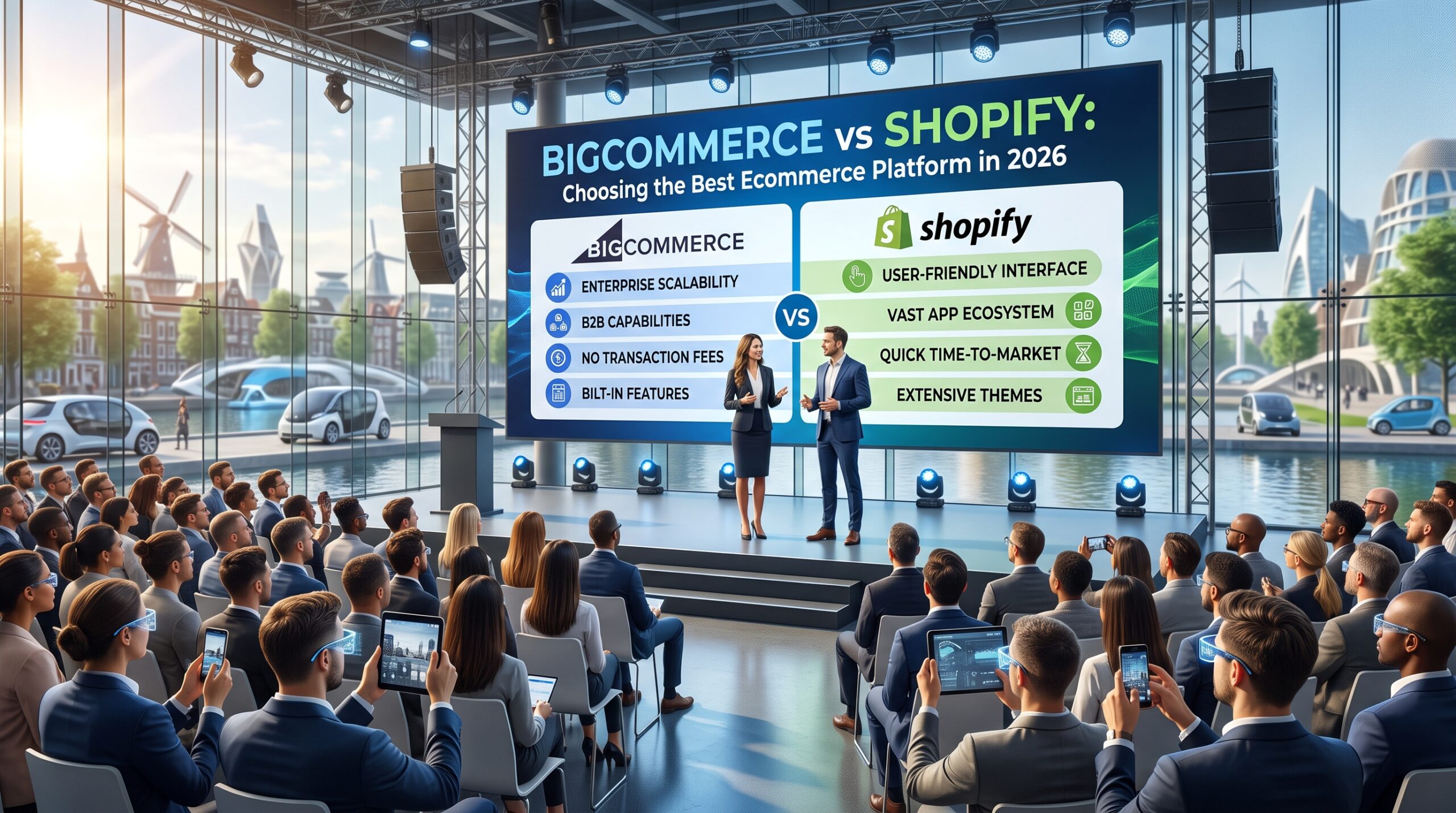
An effective ecommerce platform manages the critical backend operations of an online store. From store hosting to order fulfillment, the platform empowers entrepreneurs to focus on sales and marketing.
BigCommerce and Shopify have emerged as leading options in the ecommerce platform space. Shopify powers over 1 million businesses with its easy-to-use SaaS model. BigCommerce offers enterprise-grade capabilities for high-growth brands.
This blog performs an unbiased head-to-head comparison across 50+ factors to help readers make an informed decision in 2026. We analyze pricing, features, performance, marketing tools, and more.
By the end, you’ll understand the key strengths and differences between BigCommerce and Shopify. You’ll also gain actionable insights to choose the best platform for your online business.
What is BigCommerce?
Overview
BigCommerce was founded in 2009 and has since evolved into a top ecommerce platform supporting over 60,000 online stores.
It offers an intuitive SaaS model like Shopify along with powerful enterprise functionality. BigCommerce provides robust built-in features coupled with flexible customization.
Key capabilities include:
- Storefronts and shopping carts
- Product catalog management
- Order processing and shipping
- Payments and tax calculations
- Analytics and reporting
BigCommerce integrates with hundreds of applications to enhance functionality. It also offers seamless selling across Google, Instagram, Amazon, and more.
Pros and Cons
Advantages of BigCommerce
- More advanced features compared to Shopify, including custom checkout pages, advanced promotions, and CSV product uploads.
- Lower transaction fees (2.9% + 30¢ per online transaction).
- Built-in integration with major online marketplaces.
- Better SEO capabilities through customizable URLs and metadata.
Disadvantages of BigCommerce
- Less flexibility in design with fewer free themes. Shopify has a bigger theme marketplace.
- Limited native payment gateway support compared to Shopify. Requires third-party integrations.
- Higher cost of entry. Shopify’s basic plan is only $29/month versus $99.95 for BigCommerce.
What is Shopify?
Overview
Shopify powers over 1 million businesses with its user-friendly ecommerce platform. It was founded in 2006 and has become synonymous with retail ecommerce.
Key features include:
- Online store hosting and management
- Shopping cart and checkout
- Product catalog and inventory
- Multiple sales channels
- Payment processing
- Marketing tools
Shopify offers a mobile POS system for in-store sales. It also provides hardware like card readers. Apps and integrations further enhance functionality.
The Shopify platform aims to make ecommerce easy for small businesses. It offers 4 progressively advanced pricing plans. Shopify Plus caters to enterprise brands.
Pros and Cons
Advantages of Shopify
- Extremely easy to use and manage even for ecommerce beginners. Quick and intuitive store setup.
- Massive app marketplace with over 5,000 apps to extend functionality.
- Wide range of themes and template customization capabilities.
- Built-in fraud analysis and business reporting.
Disadvantages of Shopify
- Transaction fees of 2.4% – 2.9% + 30¢ are higher compared to BigCommerce.
- Less advanced built-in functionality like promotions and customer groups. Requires more apps.
- Shopify Payments are convenient but limit payment gateway options.
BigCommerce vs Shopify: Feature Comparison
Examining how BigCommerce and Shopify stack up across key ecommerce features provides important insights. We dive into their similarities and differences.
Pricing
BigCommerce pricing plans range from $99.95 to $249.95 per month. There are no transaction fees apart from the processing costs.
Shopify’s plans start at $29 per month and go up to $299 per month. Transactions fees range from 2.4% to 2.9% based on the plan.
| Plan | BigCommerce | Shopify |
|---|---|---|
| Starter | $99.95/month | $29/month |
| Mid-Tier | $249.95/month | $79/month |
| Advanced | $399.95/month | $299/month |
| Transaction Fee | 2.9% + 30¢ | 2.4% – 2.9% + 30¢ |
Other costs like payment processing, themes, apps, and add-ons apply for both platforms. Shopify charges extra for certain advanced features while BigCommerce includes them in its core plans.
Overall, BigCommerce offers more value for the price when all costs are considered. But Shopify has a lower barrier to entry.
Ease of Use
Shopify is slightly easier to use compared to BigCommerce for ecommerce beginners. It offers a straightforward dashboard and guided onboarding. This Shopify review found that most users can create an online store within a day.
BigCommerce has a steeper learning curve. But its interface is still beginner-friendly. Detailed help docs and 24/7 customer support help businesses get started.
Experienced merchants may prefer BigCommerce for the advanced built-in features and customization. But Shopify remains ideal for small businesses wanting a simpler solution.
Themes and Design
Both BigCommerce and Shopify offer hundreds of professional themes for store customization.
Shopify has a larger theme marketplace with over 6,000 free and paid themes. These cater to different business types and niches.
BigCommerce has around 65 free and paid themes. The options are more limited but highly customizable. BigCommerce themes are also optimized for fast performance.
For most users, Shopify provides greater design flexibility. But BigCommerce stores can achieve a more tailored, high-end look through customization.
Payment Gateways
Shopify Payments is the default payment processor on Shopify. It offers a convenient integration at competitive rates. But Shopify users can also integrate alternate gateways like Stripe.
BigCommerce has built-in support for over 45 domestic and international payment methods. Users can integrate 100+ additional gateways through open API.
Shopify provides a simpler payments setup. BigCommerce enables seamless integration of multiple payment options from a single account.
Advanced Shopify plans have lower transaction fees (2.4%) compared to BigCommerce (2.9% + 30¢).
SEO Capabilities
Shopify and BigCommerce both provide good built-in SEO features for optimizing online stores.
BigCommerce edges out Shopify when it comes to customization for on-page SEO. It offers customizable URLs, meta information, XML sitemaps, and more.
Shopify still has strong SEO capabilities. Third-party apps can also enhance Shopify’s on-page SEO.
In general, merchants report good SEO results from both platforms. The product pages and content you create will have a bigger impact than minute technical differences.
Apps and Integrations
The Shopify App Store offers over 5,000 apps to extend platform capabilities. BigCommerce has around 600 apps in its app marketplace.
Both provide integrations with critical third-party tools for payments, accounting, marketing, and more. Overall, Shopify has the largest extension ecosystem.
But BigCommerce offers better native functionality out of the box. Shopify users often need apps to replicate BigCommerce’s built-in features. This adds to the overall cost.
Scalability
Shopify Basic to Advanced plans are designed for small to mid-sized businesses. Shopify Plus caters to enterprise merchants with advanced features and dedicated support.
BigCommerce works well for both small and large online stores. All plans can handle significant sales volumes without upgrading. Unique enterprise features like price lists and B2B portals enhance scalability.
So BigCommerce provides more robust scalability in its core offering. But Shopify Plus can still compete for enterprise-level stores through customization.
Customer Support
Shopify provides 24/7 email, live chat, and phone support. Users can also access an extensive help center with tutorials, videos, and guides. However, some customers report slow resolution times.
BigCommerce offers 24/7 live chat, email, and phone assistance. The support team is both knowledgeable and responsive, according to users. Extensive help docs and forums provide extra support.
Overall, BigCommerce tends to offer slightly better customer service. But both platforms provide multiple support channels.
BigCommerce vs Shopify: Performance and Reliability
Technical factors like uptime, speed, and security impact the shopping experience. We compare how BigCommerce and Shopify stack up.
Uptime and Speed
Shopify and BigCommerce both have outstanding uptime records exceeding 99.9%. Downtime is minimal across both platforms.
BigCommerce edges out Shopify slightly when it comes to site speed and performance. But both are highly optimized for fast loading times.
Third-party performance optimization apps can further improve speed on either platform. Overall, merchants can expect excellent reliability and response times from both Shopify and BigCommerce.
Security
Shopify and BigCommerce invest heavily in security and compliance.
Both provide secure TLS connections, Fraud analysis, PCI compliance etc. to protect merchant and customer data.
BigCommerce partners with security firms like McAfee and Norton to stay ahead of threats through real-time monitoring. It’s certified Level 1 PCI DSS compliant (Source), which is the highest level of compliance for handling credit card information. The platform also offers SSL certificates, fraud detection, and regular security audits.
Shopify also uses AI and machine learning to combat fraud. It offers a Fraud Protect app for risk analysis.
Ultimately, both offer enterprise-grade security. Merchants can feel confident trusting either platform. Implementing additional security apps can provide even more protection.
BigCommerce vs Shopify: Marketing and Sales Tools
Shopify and BigCommerce provide extensive built-in tools to boost marketing and sales. We examine how the two platforms compare.
Built-in Marketing Tools
Both platforms offer native tools for:
- Email marketing and automation
- Abandoned cart recovery
- Marketing campaigns
- Customer segmentation
- Affiliate management
Shopify provides more built-in features for social selling on Facebook and Pinterest.
BigCommerce edges out Shopify for email marketing automation and reporting. It also provides better analytics.
Additional marketing apps can expand the capabilities on both platforms as needed.
Sales Channels
Shopify and BigCommerce support multi-channel sales on:
- Online marketplaces like Amazon, eBay, and Google Shopping
- Social media platforms
- Bricks-and-mortar retail through POS integration
BigCommerce offers deeper marketplace integration for Amazon, eBay, Wish, and Walmart. Shopify requires third-party apps for some channels.
Shopify provides native integration with popular social platforms. BigCommerce requires apps for some social selling features.
Both platforms enable comprehensive multi-channel selling overall. But BigCommerce has the edge for retail marketplaces while Shopify leads for social integration.
Analytics and Reporting
Shopify and BigCommerce provide an array of reports on sales, customers, inventory, expenses etc. to inform business decisions.
BigCommerce offers slightly more advanced real-time analytics and tracking. Shopify analytics are still robust but focused on simpler metrics like sales and traffic reports.
Both platforms integrate with Google Analytics for expanded reporting. Additional analytics apps are also available.
So BigCommerce has an edge when it comes to native reporting functionality. But the analytics capabilities can be expanded on Shopify as needed.
BigCommerce vs Shopify: Pricing + Making the Switch
A detailed look at pricing models and the process of switching platforms.
Understanding Ecommerce Costs
The monthly SaaS fee is one part of total ecommerce costs. Additional costs include:
- Transaction and payment processing fees
- Domain registrations
- Themes and design customization
- Marketing tools and apps
- SSL certificates and hosting fees
Complex platforms like Shopify often incur more app and customization costs. Simpler solutions like BigCommerce include more built-in functionality.
You must analyze both recurring and one-time costs when selecting a platform. This ensures accurate budgeting and ROI analysis.
Migration Process
Migrating from one ecommerce platform to another takes planning but is doable. Here are the steps for a smooth transition:
- Set up your new store and themes but don’t launch it.
- Use import/export tools to transfer products, orders, customers etc.
- Install apps and integrations you need on the new platform.
- Sync inventory quantities using automated or manual processes.
- Thoroughly test the new store and fix bugs.
- Go live with the new store! Redirect traffic and shut down your old store.
Shopify and BigCommerce both provide data migration services. This simplifies moving stores between the two platforms.
Why Businesses are Making the Switch
Understanding why merchants are moving from Shopify to BigCommerce (and vice versa) reveals user sentiments.
Reasons for Switching from Shopify to BigCommerce
- Lower long-term costs when all fees are considered.
- More advanced built-in features like promotions.
- Enterprise-level scalability and customization.
- Better SEO control and customization.
Reasons for Switching from BigCommerce to Shopify
- Simpler onboarding and user experience.
- Larger app ecosystem and theme selection.
- Easier integration with social selling channels.
- Entry-level plans more affordable for small stores.
Benefits after Switching Platforms
- Lower costs while maintaining or expanding features.
- Increased sales through better performance and SEO.
- Improved conversion optimization from features like promotions.
- Greater scalability to support business growth.
- Enhanced branding and design capabilities.
By understanding pros and cons, merchants can make ideal platform choices aligned to their business needs and goals.
BigCommerce Success Stories
Let’s look at real-world examples of growing brands using BigCommerce effectively.
Skullcandy – Audio Equipment Company
- Grew international sales by 50% within 5 months of switching to BigCommerce.
- BigCommerce’s native multi-language and multi-currency capabilities supported their global expansion.
- They utilized BigCommerce’s Storefront API to create a visually compelling custom storefront.
Paul Evans – Luxury Italian Shoes
- Launched their online business on BigCommerce in 2013.
- Leveraged the platform’s enterprise features to scale rapidly.
- BigCommerce’s flexible API allowed them to deliver a premium branded experience.
- They were able to expand globally and experience explosive 13,000% revenue growth within 3 years.
These examples showcase BigCommerce’s ability to support both growth and excellent branding for ecommerce businesses.
What is the Difference Between BigCommerce and Shopify?
While BigCommerce and Shopify share many similarities, the key differences are:
User Experience
- Shopify offers greater ease of use, simpler onboarding and UI.
- BigCommerce has a steeper learning curve but provides powerful built-in features.
Design Flexibility
- Shopify provides more themes and direct design customization.
- BigCommerce limits theme options but enables deep branding customization through APIs.
Built-in Functionality
- Shopify requires numerous apps to replicate BigCommerce’s native features.
- BigCommerce offers more advanced capabilities out of the box.
Pricing
- Shopify has lower starting prices but higher transaction fees.
- BigCommerce costs more initially but fewer add-ons needed.
Enterprise Suitability
- Shopify Plus competes for large brands through extensive customization.
- BigCommerce natively supports enterprise needs.
By focusing on these 5 key differences, merchants can determine which platform better meets their needs.
What Sales Features Do BigCommerce and Shopify Offer?
Let’s examine some of the core sales capabilities both platforms provide.
Sales Tools
Shopify
- Shopify POS for in-store sales
- Shopping cart and checkout process
- Apple Pay and Google Pay integration
- Shopify Payments processing
- Abandoned cart recovery
- Gift cards
BigCommerce
- Single cart across all channels
- Advanced promotional tools like discounts and coupons
- Customizable checkout pages
- Built-in payments integration
- Abandoned cart saver
- Gift certificates
Both platforms provide robust tools to optimize online and offline sales. BigCommerce edged out Shopify for advanced promotions. But Shopify offers native in-store capabilities.
See How Shopify+ and BigCommerce Compare for Enterprise Ecommerce
For large enterprise brands, we compare BigCommerce and Shopify Plus.
Enterprise Features
Shopify Plus
- Custom storefront design
- Wholesale channel access
- Volume discounts
- Custom reporting
- Dedicated account management
- High sales volume support
BigCommerce
- Advanced promotions and pricing
- Role-based user permissions
- B2B ecommerce support
- Complex order management
- Multi-location inventory tracking
- Sales reps and reseller tools
BigCommerce provides more turnkey enterprise capabilities. But Shopify Plus offers tailored customization and support for huge brands.
Both are designed to scale efficiently for large stores while delivering customized shopping experiences.
Future Outlook: BigCommerce vs Shopify in 2025
Let’s examine predictions for BigCommerce and Shopify’s future standing.
Trends and Predictions
- Shopify will likely retain its lead for simplicity and ease of use.
- BigCommerce is expected to expand its mid-market share.
- Both platforms will incorporate more AI and automation.
- Direct-to-consumer selling will be a focus area.
- Tighter platform integrations will drive omnichannel retail.
Expert Opinions
According to Paul Rogers, Director of Strategy at OneIMS:
“Shopify will continue its growth trajectory in 2025 by providing an easy entry point to ecommerce. But merchants may migrate to BigCommerce over time seeking more robust capabilities to manage at scale.”
Gartner predicts:
“By 2025, 15% of large organizations will have moved their ecommerce platforms from SaaS providers like Shopify and BigCommerce to custom-developed or headless architectures.”
So while Shopify is likely to dominate the SMB space, BigCommerce will be a top contender among mid-market and enterprise brands. Custom headless commerce platforms may also gain adoption by 2025.
Conclusion
Choosing between Shopify and BigCommerce requires in-depth analysis of business requirements, growth goals, and platform capabilities.
Smaller merchants may benefit more from Shopify’s simplicity and app ecosystem to launch their first online store.
Mid-market or rapidly scaling brands often get better ROI from BigCommerce’s broader native feature set. Although you can’t go wrong with either platform, aligning platform strengths to your priorities is key.
Weigh factors like built-in features, long-term costs, design flexibility, scalability, and ease of use. Try out the free trial for both BigCommerce and Shopify. Compare their dashboard interfaces. Reach out to sales representatives with any questions.
With this head-to-head comparison, you now have the insights to confidently choose the best ecommerce platform for your business today and in 2026. The strategic decisions you make at this stage will enable sustainable growth and success for years to come.
Common BigCommerce vs Shopify Questions
Which platform is better for small businesses?
Shopify’s simplicity and affordability make it ideal for small businesses to launch their first store. BigCommerce also works well for small brands but has a costlier starting price.
Can I easily migrate from one platform to another?
Yes, both Shopify and BigCommerce offer data migration tools to simplify switching platforms. Following the migration best practices minimizes downtime and errors.
How do the customer support services compare?
BigCommerce tends to receive higher reviews from merchants for providing responsive and knowledgeable support 24/7 through various channels. Shopify also has extensive support but some merchants report longer delays.
What are the key SEO differences?
BigCommerce edge’s out Shopify slightly when it comes to customizable URLs, meta tags, and other on-page SEO factors. But Shopify also provides strong SEO capabilities either natively or through apps.
Are there any hidden or additional costs to watch out for?
The monthly SaaS fees are just one cost component. Transaction fees, apps, design services, marketing tools, and add-ons can increase the total cost. Carefully add up all recurring and one-time expenses.
In conclusion, the choice between BigCommerce and Shopify ultimately depends on your business requirements, budget, and growth plans. By carefully evaluating the features, pricing, and support offered by each platform, you can make an informed decision that sets your ecommerce venture up for success in 2026 and beyond.
Take advantage of free trials, explore the platforms’ resources, and consult with experts to gain a better understanding of which platform aligns best with your goals. With the right ecommerce platform as your foundation, you can focus on growing your business and delivering exceptional experiences to your customers.